S. 3949 · 117th Congress
Trafficking Victims Prevention and Protection Reauthorization Act of 2022
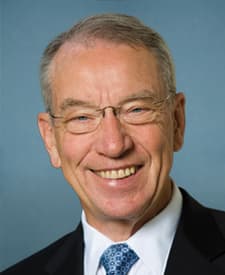
Introduced on Mar 29, 2022 by Chuck Grassley (R-IA). One cosponsor. Became Public Law 117-348.
- Stage
- Became law
- Public Law 117-348
- Introduced
- Mar 29, 2022
- Cosponsors
- 1
- 1 from the other party
- Policy area
- Crime and Law Enforcement
Progress
The furthest stage the measure reached. Simple and concurrent resolutions do not go to the President.
- Introduced
- Reported by committee
- Passed one chamber
- Passed both chambers
- Sent to the President
- Became law
Official title
A bill to reauthorize the Trafficking Victims Protection Act of 2000, and for other purposes.
Subjects
- Administrative law and regulatory procedures
- Adoption and foster care
- Advisory bodies
- Assault and harassment offenses
- Business ethics
- Child safety and welfare
- Civil actions and liability
- Computer security and identity theft
- Congressional oversight
- Contracts and agency
- Crime prevention
- Crime victims
- Crimes against children
- Criminal investigation, prosecution, interrogation
- Criminal justice information and records
- Criminal procedure and sentencing
- Customs enforcement
- Domestic violence and child abuse
- Drug, alcohol, tobacco use
- Employee benefits and pensions
- Employee hiring
- Employee performance
- Employment and training programs
- Evidence and witnesses
- Fraud offenses and financial crimes
- Government employee pay, benefits, personnel management
- Government ethics and transparency, public corruption
- Government information and archives
- Government studies and investigations
- Health care costs and insurance
- Higher education
- Human rights
- Human trafficking
- Immigration status and procedures
- Juvenile crime and gang violence
- Labor standards
- Labor-management relations
- Law enforcement administration and funding
- Mental health
- Pornography
- Public contracts and procurement
- Sex offenses
- Smuggling and trafficking
- State and local government operations
- Trade restrictions
- Visas and passports
- Vocational and technical education
- Wages and earnings
- Youth employment and child labor
Summary
By the Congressional Research Service (Public Law, Jan 5, 2023). Public domain.
Trafficking Victims Prevention and Protection Reauthorization Act of 2022
This act reauthorizes, updates, and expands federal efforts to address domestic trafficking, including to make permanent the U.S. Advisory Council on Human Trafficking; reauthorize various grants, activities, and programs that support victims of domestic trafficking; and expand research and reporting related to trafficking.
TITLE I--COMBATING TRAFFICKING IN PERSONS IN THE UNITED STATES
Subtitle A--Programs To Support Young Victims Who Are Vulnerable To Human Trafficking
(Sec. 101) This section authorizes the Department of Health and Human Services (HHS), in collaboration with the Department of Justice (DOJ), to award competitive grants to support collaboration between state child-welfare and juvenile-justice agencies to address the needs of dual-status youth and their families. The term dual-status youth means children who come into contact with both the child welfare and juvenile justice systems.
(Sec. 102) This section makes permanent the U.S. Advisory Council on Human Trafficking.
Read the full summary
(Sec. 103) This section establishes a pilot program to provide funding for community-based organizations in underserved communities to support youth at risk of being trafficked.
Subtitle B--Governmental Efforts To Prevent Human Trafficking
(Sec. 121) This section requires the Government Accountability Office (GAO) to report to Congress on federal contract supply chain oversight related to the prevention of trafficking in persons.
(Sec. 122) This section expresses the sense of Congress that
- federal agencies should incorporate a module on human trafficking into staff training requirements;
- the training should teach employees how to prevent, identify, and report trafficking in persons; and
- agencies should inform all candidates for employment about the anti-trafficking provisions in the code of conduct of the agency.
Additionally, this section requires officers and employees of executive branch agencies to be subject to minimum standards with respect to human trafficking, including a prohibition on engaging in human trafficking while employed by the federal government.
(Sec. 123) This section requires the GAO to (1) study the accessibility of mental health services and substance use disorder treatment and recovery for survivors of human trafficking in the United States of various ages, and (2) report to Congress on the findings of the study and recommendations for increased accessibility and affordability for survivors of trafficking.
(Sec. 124) This section directs the National Science Foundation to support merit-reviewed and competitively awarded research on the impact of online social media platforms on the maintenance or expansion of human trafficking.
Subtitle C--Monitoring Child, Forced, and Slave Labor
(Sec. 131) This section requires federal agencies and departments that receive appropriations to award anti-trafficking grants to report on obligations and expenditures of federal funds for the purpose of combating human trafficking and forced labor.
(Sec. 132) This section expresses the sense of Congress that companies headquartered or doing business in the United States that are not small business concerns (e.g., companies with 500 or more employees) should adopt a written policy that prohibits trafficking in persons.
(Sec. 133) This section revises criteria for considering a child to be a victim of child abuse and neglect and of sexual abuse. Specifically, it provides that a child shall be considered a victim of child abuse and neglect and of sexual abuse if the child is identified as being a victim of human trafficking. Currently, a child is considered a victim of child abuse and neglect and of sexual abuse if the child is identified as being a victim of sex trafficking or a victim of severe forms of trafficking in persons.
(Sec. 134) This section establishes the sense of Congress that (1) DOJ has failed to meet its reporting requirements under Title IV of the Trafficking Victims Protection Act of 2017, and (2) progress on critical data collection about human trafficking and crime reporting is in jeopardy as a result of the failure and must be addressed immediately.
(Sec. 135) This section expresses the sense of Congress that (1) a person is qualified as a victim of child sex trafficking if the person is a victim, as a child, of human trafficking; and (2) all states and territories should evaluate whether to eliminate the requirement for third-party control to properly qualify a child as a victim of sex trafficking.
(Sec. 136) This section expresses the sense of Congress that each state child welfare agency should report information on missing or abducted foster children and youth to the National Center on Missing and Exploited Children (NCMEC) and to law enforcement for inclusion in the National Crime Information Center database.
(Sec. 137) This section modifies the requirements for state plans for foster care and adoption assistance. The section specifies that the plans must require state child welfare agencies that report information on missing or abducted foster children and youth to the NCMEC and to law enforcement authorities to maintain regular communication and share information with the NCMEC and law enforcement agencies to provide a safe recovery of a missing or abducted child or youth. This includes sharing, where reasonably possible, a photo of the missing or abducted child or youth, a description of the child's physical features, and other health or risk factors (e.g., pregnancy status or vulnerability to being sex trafficked).
TITLE II--AUTHORIZATION OF APPROPRIATIONS
This title reauthorizes activities and programs at various federal departments and agencies that support victims of trafficking in the United States.
(Sec. 201) This section reauthorizes through FY2028
- HHS and DOJ grants and programs to expand benefits and services to citizens and lawful permanent residents who are victims of severe forms of trafficking;
- Department of Labor activities to expand benefits and programs for victims of severe forms of trafficking; and
- Department of Homeland Security (DHS) authority to investigate severe forms of trafficking in persons, including to establish a labor trafficking investigations team within DHS.
(Sec. 202) This section authorizes amounts through FY2028 for U.S. Customs and Border Protection to strengthen enforcement of the prohibition on importing any product that was mined, produced, or manufactured by forced labor.
Sponsor and cosponsors
Cosponsors by party as of the day they signed on. Original cosponsors signed on the day of introduction.
Democrats · 1
- Dianne FeinsteinD-CAoriginal
Roll calls
Recorded votes on the measure. Most measures move by voice vote or unanimous consent, which record no individual positions.
No recorded roll call on this measure: it moved by voice vote or unanimous consent, or has not reached the floor.
History
Every action as published, oldest first. Roll calls link to how each member voted.
- Mar 29, 2022Introduced in Senate
- Mar 29, 2022 · SenateRead twice and referred to the Committee on the Judiciary.
- Dec 20, 2022Senate Committee on the Judiciary discharged by Unanimous Consent.
- Dec 20, 2022 · SenateSenate Committee on the Judiciary discharged by Unanimous Consent.
- Dec 20, 2022 · SenateMeasure laid before Senate by unanimous consent. (consideration: CR S9613)
- Dec 20, 2022Passed/agreed to in Senate: Passed Senate with an amendment by Unanimous Consent.(text of amendment in the nature of a substitute: CR S9661-9665)
- Dec 20, 2022 · SenatePassed Senate with an amendment by Unanimous Consent. (text of amendment in the nature of a substitute: CR S9661-9665)
- Dec 21, 2022 · SenateMessage on Senate action sent to the House.
- Dec 21, 2022 · HouseReceived in the House.
- Dec 21, 2022 · HouseHeld at the desk.
- Dec 22, 2022 · HouseMr. Nadler moved to suspend the rules and pass the bill.
- Dec 22, 2022 · HouseConsidered under suspension of the rules. (consideration: CR H10013-10018)
- Dec 22, 2022 · HouseDEBATE - The House proceeded with forty minutes of debate on S. 3949.
- Dec 22, 2022Passed/agreed to in House: On motion to suspend the rules and pass the bill Agreed to by voice vote.(text: CR H10013-10017)
- Dec 22, 2022 · HouseOn motion to suspend the rules and pass the bill Agreed to by voice vote. (text: CR H10013-10017)
- Dec 22, 2022 · HouseMotion to reconsider laid on the table Agreed to without objection.
- Dec 28, 2022Presented to President.
- Dec 28, 2022 · HousePresented to President.
- Jan 5, 2023Signed by President.
- Jan 5, 2023Signed by President.
- Jan 5, 2023Became Public Law No: 117-348.
- Jan 5, 2023Became Public Law No: 117-348.
Committees
Committees and subcommittees the measure was referred to.
Agencies in its committees' jurisdiction
Analisa's mapping of committee jurisdiction to federal agencies; the bill may touch others, or none of these.
Who lobbied on it
Organizations whose lobbying reports (LD-2) name this measure. Spending is what they reported for those quarters on all issues, not on this measure alone.
- Covenant House1 report$50K reported (all issues)
Reports filed in 2023.
Sources and method
Every figure on this page traces to these records.
- Bill status: bills and resolutions, sponsors, actions, subjects and CRS summaries (U.S. Government Publishing Office (GovInfo), from Congress.gov (Library of Congress))GovInfo Bill Status bulk data (Congress.gov; summaries by the Congressional Research Service) · data current to Oct 3, 2026 · loaded Oct 3, 2026 · license: Public domain (U.S. Government work, 17 U.S.C. § 105)
- Members of Congress, their terms, committees and identifiers (The @unitedstates project (from the Biographical Directory of the U.S. Congress, the House and the Senate))unitedstates/congress-legislators: legislators, committees and current committee membership · data current to Oct 3, 2026 · loaded Oct 3, 2026 · license: CC0 1.0 (public domain dedication)
- House roll-call votes (Office of the Clerk, U.S. House of Representatives)Office of the Clerk, U.S. House of Representatives, roll-call vote records · data current to Oct 3, 2026 · loaded Oct 3, 2026 · license: Public domain (U.S. Government work, 17 U.S.C. § 105)
- Senate roll-call votes and DW-NOMINATE scores (Voteview (UCLA Department of Political Science))Lewis, Jeffrey B., Keith Poole, Howard Rosenthal, Adam Boche, Aaron Rudkin, and Luke Sonnet (2026). Voteview: Congressional Roll-Call Votes Database. https://voteview.com/ · data current to Oct 3, 2026 · loaded Oct 3, 2026 · license: Free to use with the required citation
- Lobbying disclosures (LD-1 registrations, LD-2 quarterly reports, LD-203 contribution reports) (Clerk of the U.S. House of Representatives)Clerk of the House, Lobbying Disclosure Act filings (organizations only; lobbyists' names are not loaded) · data current to Oct 5, 2026 · loaded Oct 5, 2026 · license: Public domain (U.S. Government work, 17 U.S.C. § 105)
- Positions are shown only where a roll call recorded them; voice votes and unanimous consent record none.
- Money and votes are shown side by side; neither explains the other.